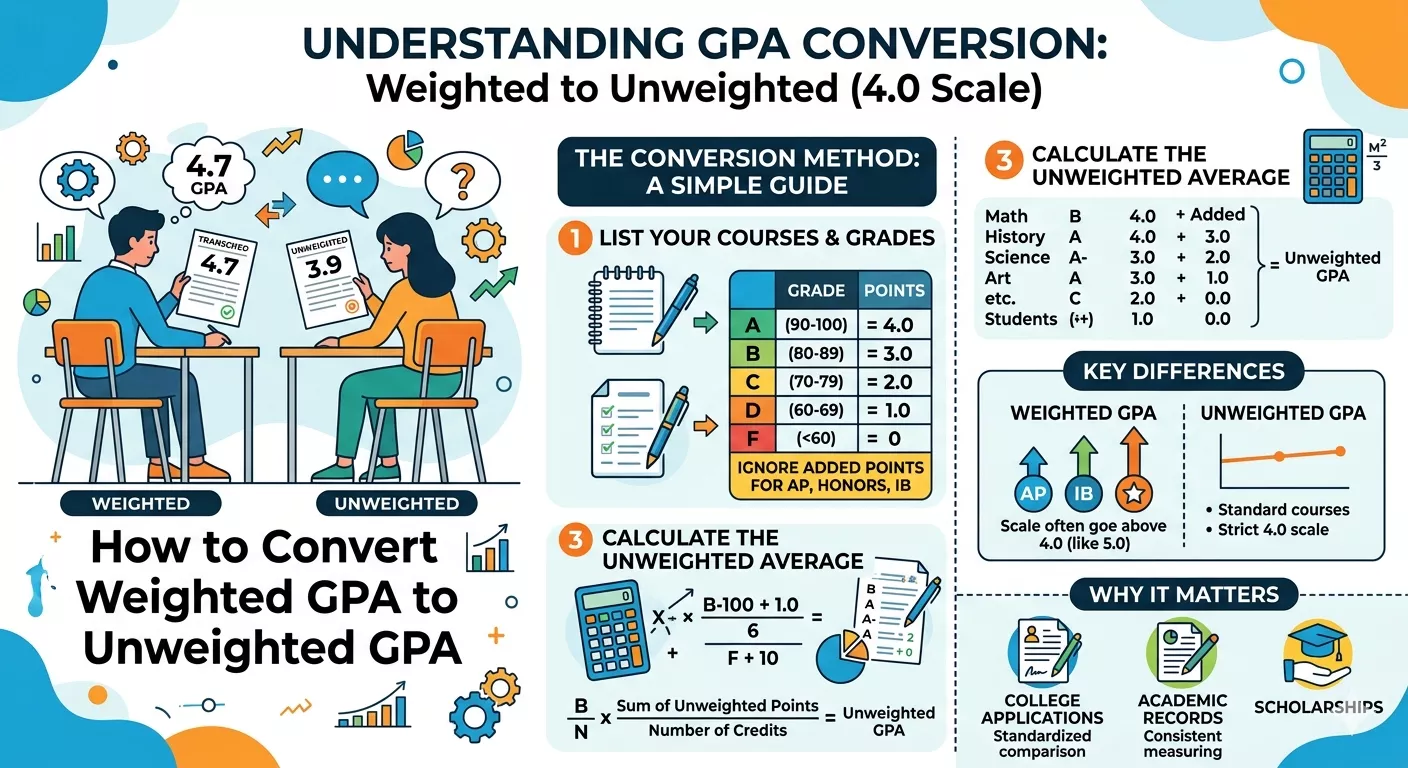
Students get confused about GPA systems all the time, especially when schools use different grading methods. One transcript shows a 4.7 GPA while another shows a 3.9, and suddenly everyone starts comparing numbers that aren’t even measured the same way. It feels a little like using a bmi calculator without knowing the units first. The number matters, but the scale behind it matters too. Understanding how schools convert grades helps make sense of college applications and academic records.
Table of Contents
Understanding How to Convert Weighted GPA to Unweighted
The phrase Convert Weighted GPA to Unweighted sounds technical at first, but the process is usually simpler than people expect. A weighted GPA includes extra points for difficult courses like honors classes GPA or AP classes GPA. An unweighted GPA removes those extra points and places every class back onto a standard 4.0 GPA scale.
Most schools use weighted GPA systems to reward students for taking challenging courses. A student earning an A in AP Chemistry might receive a 5.0 instead of a 4.0. Another student earning an A in a regular class gets the standard 4.0.
When converting weighted GPA to unweighted GPA, those extra points are removed so all grades are treated equally.
Why schools use weighted GPA systems
Schools don’t want difficult courses to hurt class ranking or academic performance. If a student takes several AP classes GPA courses, they are usually handling more difficult material than someone taking only standard classes.
Weighted GPA exists to reflect that difference.
Here’s a basic comparison:
| Course Type | A Grade Value |
|---|---|
| Regular Class | 4.0 |
| Honors Class | 4.5 |
| AP Class | 5.0 |
This is where weighted vs unweighted GPA becomes important. Colleges often review both numbers during college admissions GPA evaluations.
Weighted GPA vs unweighted GPA
A weighted GPA measures both grades and course difficulty. An unweighted GPA measures grades only.
That’s the main distinction.
If two students both earn straight As, but one takes advanced classes, the weighted GPA will likely be higher. Their unweighted GPA may still match.
Students often use a percentage calculator mindset when trying to compare GPAs because they want a clean conversion, but GPA systems are rarely identical from school to school.
The standard 4.0 GPA scale explained
Most unweighted GPA systems use the 4.0 GPA scale.
Here’s the common breakdown:
| Letter Grade | GPA Value |
|---|---|
| A | 4.0 |
| B | 3.0 |
| C | 2.0 |
| D | 1.0 |
| F | 0.0 |
Some schools include plus and minus grading.
| Grade | GPA |
|---|---|
| A- | 3.7 |
| B+ | 3.3 |
| B- | 2.7 |
This system removes extra weighting from honors classes GPA and AP classes GPA.
Easy method to calculate unweighted GPA from weighted GPA
The simplest method is not direct subtraction. That’s where students get confused.
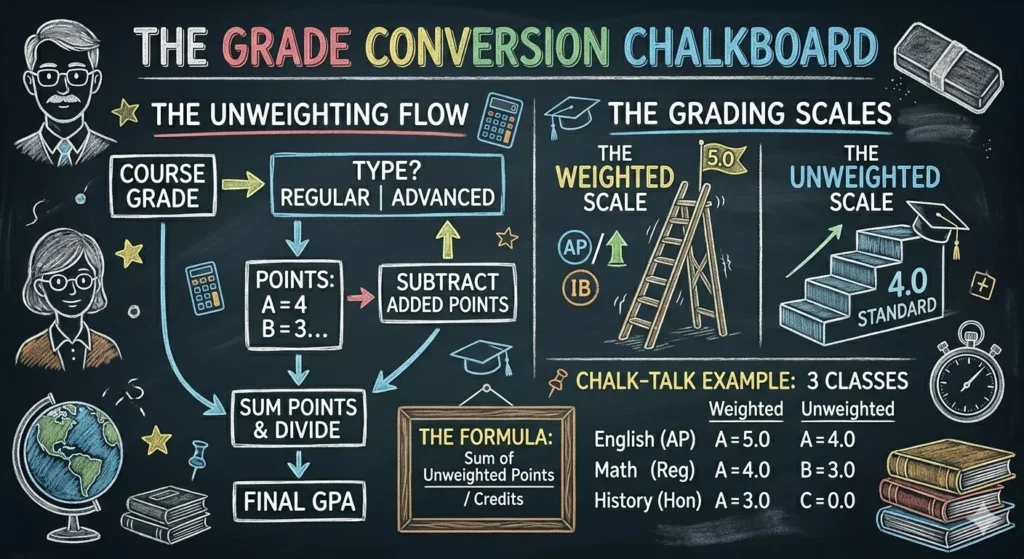
You don’t usually take a weighted GPA like 4.6 and simply “convert” it mathematically. Instead, you recalculate every course grade using the standard GPA scale.
Here’s the process:
- List all classes
- Remove weighted bonus points
- Assign standard GPA values
- Add total grade points
- Divide by number of classes
That gives the unweighted GPA.
Step by step guide for converting weighted GPA to unweighted GPA
Imagine a student has these grades:
| Course | Grade | Weighted Value |
|---|---|---|
| AP Biology | A | 5.0 |
| Honors English | B | 3.5 |
| Regular Math | A | 4.0 |
| Regular History | B | 3.0 |
To convert weighted GPA to unweighted, remove weighting bonuses.
| Course | Unweighted Value |
|---|---|
| AP Biology | 4.0 |
| Honors English | 3.0 |
| Regular Math | 4.0 |
| Regular History | 3.0 |
Now average them:
4 + 3 + 4 + 3 = 14
14 ÷ 4 = 3.5 unweighted GPA
That’s the basic method.
Why colleges care about both GPA systems?
Some colleges focus heavily on weighted GPA because it shows rigor. Others prefer unweighted GPA for easier comparison between schools.
A school with aggressive weighting might produce many students above 4.5, while another school caps weighted GPA at 4.2. Comparing them directly becomes messy.
Admissions offices usually review:
- Weighted GPA
- Unweighted GPA
- Course rigor
- Class ranking
- Academic performance trends
Even a strong cumulative GPA gets evaluated alongside course difficulty.
How honours classes GPA changes weighted scores
Honors courses usually add a half-point bonus.
For example:
| Grade | Regular GPA | Honors GPA |
|---|---|---|
| A | 4.0 | 4.5 |
| B | 3.0 | 3.5 |
This means students taking several honors classes GPA courses can build a higher weighted GPA even if their actual grades match another student’s.
Some schools treat honors differently though. There’s no universal system.
AP classes GPA and advanced weighting
AP classes GPA weighting is usually stronger.
A common system gives:
| Grade | AP GPA |
|---|---|
| A | 5.0 |
| B | 4.0 |
| C | 3.0 |
This is why students in advanced programs sometimes graduate with weighted GPA numbers above 4.5.
Still, their unweighted GPA may remain close to 4.0.
It’s similar to converting time zones with a timezone converter. The original information stays the same, but the scale changes.
Difference between weighted and unweighted GPA for college admissions
This question comes up constantly. A weighted GPA shows effort and course difficulty. An unweighted GPA shows raw grade consistency.
Colleges often prefer balance. A student with a 4.0 weighted GPA from easy classes may appear less competitive than a student with a 3.8 weighted GPA earned through difficult AP classes GPA coursework.
Context matters more than students sometimes realize.
Common GPA scales schools use
Schools don’t all follow one model.
Here are common GPA scale systems:
| GPA Scale Type | Maximum GPA |
|---|---|
| Unweighted | 4.0 |
| Weighted Honors | 4.5 |
| Weighted AP | 5.0 |
| Some District Systems | 6.0 |
This variation explains why converting weighted GPA to unweighted GPA matters during college applications.
How GPA calculator tools help
A GPA calculator saves time and reduces mistakes. Most GPA calculator tools ask for:
- Course name
- Letter grade
- Credit hours
- Course level
Then the system calculates weighted GPA and unweighted GPA automatically.
Students handling many classes often rely on GPA calculator tools because manual calculations become repetitive.
How cumulative GPA works?
- Cumulative GPA combines all semesters together.
- If freshman year grades were weak but junior year improved, the cumulative GPA reflects both periods.
- Weighted GPA and unweighted GPA can both be cumulative.
- This matters during college admissions GPA review because colleges often look for upward trends.
Class ranking and GPA comparison
Class ranking depends heavily on school policy. Some schools rank strictly by weighted GPA. Others use unweighted GPA instead. That changes outcomes significantly. A student taking advanced classes may rank higher even with slightly lower raw grades because the weighting system rewards course rigor.
Converting GPA manually without a GPA calculator
Students can absolutely do this themselves.
Here’s the manual method:
- Convert each grade to 4.0 GPA scale values
- Ignore weighting bonuses
- Add total points
- Divide by total classes
Simple example:
| Grade | GPA |
|---|---|
| A | 4 |
| B | 3 |
| A | 4 |
| C | 2 |
Total = 13
13 ÷ 4 = 3.25
That becomes the unweighted GPA.
Mistakes students make during GPA conversion
- One mistake is subtracting a fixed number from weighted GPA.
- For example, turning a 4.7 into a 4.0 automatically doesn’t work.
- Another issue comes from misunderstanding course weighting systems. Some schools add 0.5 for honors classes GPA while others add 1.0.
- Even transcript formatting can create confusion, a bit like using an age calculator with incomplete dates.
How colleges recalculate GPA themselves
Many universities recalculate GPA internally anyway. They may:
- Ignore electives
- Focus on core classes
- Remove weighting
- Use their own GPA scale
That’s why two colleges may evaluate the same transcript differently.
Why weighted GPA sometimes looks inflated
A student can technically earn above a 4.0 weighted GPA. That surprises people unfamiliar with weighted systems. For example:
| Course Type | Grade | Weighted GPA |
|---|---|---|
| AP Physics | A | 5.0 |
| AP Chemistry | A | 5.0 |
| Honors Math | A | 4.5 |
Average becomes 4.83.
The grades themselves are still straight As. The extra points come from course difficulty.
Academic performance beyond GPA
GPA matters, but colleges don’t look at it alone. Academic performance also includes:
- Standardized test scores
- Essays
- Extracurriculars
- Recommendation letters
- Leadership roles
A slightly lower weighted GPA won’t ruin college applications if the rest of the profile is strong.
How transfer students handle GPA systems?
Transfer students often experience GPA conversion issues. Different schools use different GPA scale models. One school may heavily weight AP classes GPA while another barely adjusts honors courses. Colleges usually standardize everything internally.
How to improve GPA before graduation?
- Students often panic about GPA late in high school.
- Realistically, improvement takes time.
- Raising cumulative GPA becomes harder after many semesters because earlier grades remain part of the average.
- Still, stronger recent academic performance helps during college admissions GPA review.
Understanding GPA scales internationally
- Not every country uses a 4.0 GPA scale.
- Some systems use percentages. Others use 10-point scales.
- This creates additional conversion challenges for international college applications.
- Many institutions use professional GPA calculator systems for international evaluation.
Quick comparison table for GPA systems
| Feature | Weighted GPA | Unweighted GPA |
|---|---|---|
| Includes course difficulty | Yes | No |
| Can exceed 4.0 | Yes | No |
| Easier school comparison | No | Yes |
| Rewards advanced classes | Yes | No |
| Common in high schools | Yes | Yes |
This table helps explain weighted vs unweighted GPA quickly.
Simple example using a full semester
Here’s a fuller example.
| Course | Type | Grade | Weighted GPA | Unweighted GPA |
|---|---|---|---|---|
| English | Honors | A | 4.5 | 4.0 |
| Biology | AP | B | 4.0 | 3.0 |
| Algebra | Regular | A | 4.0 | 4.0 |
| History | Regular | B | 3.0 | 3.0 |
Weighted GPA:
4.5 + 4 + 4 + 3 = 15.5
15.5 ÷ 4 = 3.875
Unweighted GPA:
4 + 3 + 4 + 3 = 14
14 ÷ 4 = 3.5
That difference comes entirely from course weighting.
How GPA affects Scholarships?
- Scholarships sometimes specify minimum GPA requirements.
- Some use weighted GPA. Others require unweighted GPA.
- Students should always check which version matters before applying.
Using GPA conversion for planning
- Understanding how to convert weighted GPA to unweighted helps students estimate competitiveness.
- It also reduces confusion during college applications when schools request different GPA formats.
- Think of it like using an energy converter. The value changes form, but the underlying information stays connected.
Final Thoughts
Weighted GPA systems reward challenge. Unweighted GPA systems focus purely on grades. Neither is automatically better. They just measure different things.
Once students understand how schools apply weighting, GPA stops feeling mysterious. The calculations become manageable, even if school policies vary a little from place to place.